
Utah Tech University Students Advance CubeSat Development Through Hands-On Engineering and Partnerships
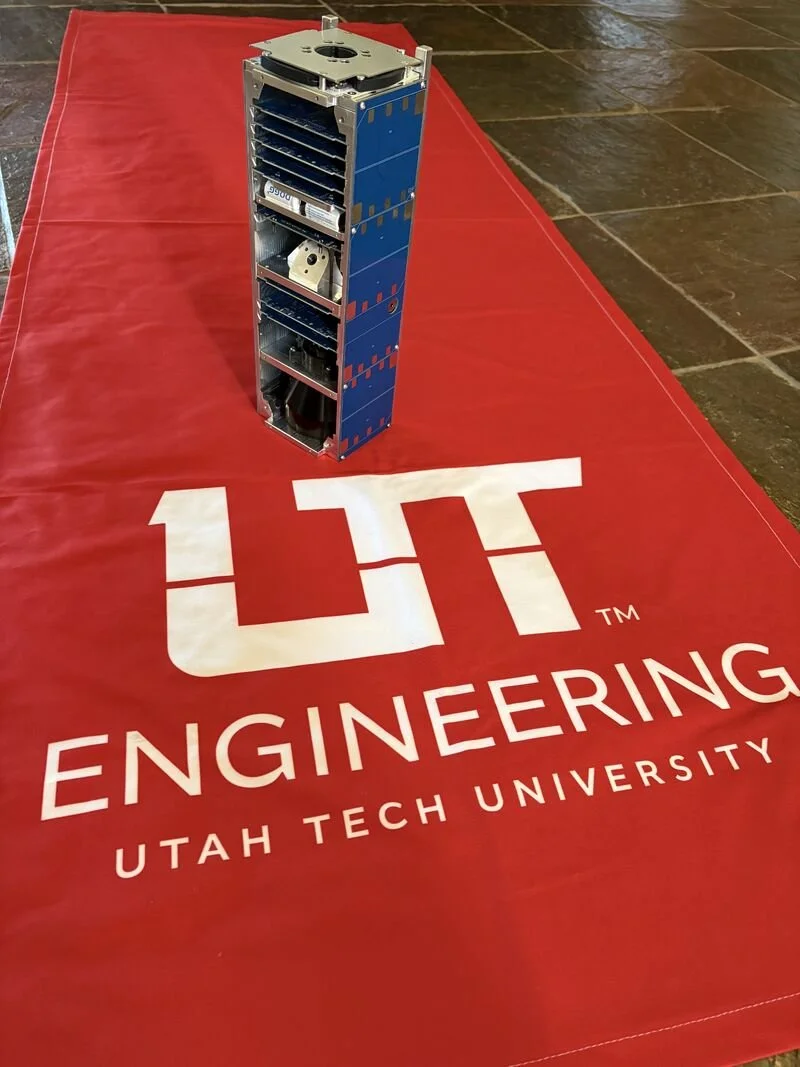
Utah Tech University's student-built 3U CubeSat showcases the engineering accomplishments of undergraduate students who designed, developed, and began testing the satellite's core systems as part of the university's senior engineering capstone program.
With support from the Utah NASA Space Grant Consortium and specialized training through the University Nanosatellite Program, Utah Tech University students are building the foundation for future student-designed satellite missions.
What began in 2024 as an ambitious undergraduate engineering project at Utah Tech University has grown into an exciting opportunity for students to gain hands-on experience in spacecraft design and development. Through the university's senior engineering capstone program, students are designing, building, and testing CubeSats—small satellites that provide valuable opportunities for space-based research and technology development. Despite limited budgets and demanding academic timelines, the student teams have made significant progress toward establishing a sustainable CubeSat program capable of supporting future missions.
During the 2025–2026 academic year, a team of 10 senior engineering students achieved a major milestone by designing, developing, building, and beginning to test the core systems of a 3U CubeSat. Building upon work completed by the previous year's team, the students developed nearly all of the satellite's major subsystems, including its structural components, electronics, control systems, and software. To reduce costs and provide students with authentic engineering experience, the team designs and manufactures many of its own components, including the CubeSat frame and internal structures. This accomplishment represents a significant achievement for an undergraduate engineering program undertaking its first satellite development efforts.
Specialized Training Strengthens the Program

Utah Tech University students (L to R) Braydon Phillips, Arick Bird, and Sean Gillam visit NASA's Kennedy Space Center as part of the 2025 University Nanosatellite Program (UNP), where they received specialized training in satellite mission development to support Utah Tech's growing CubeSat initiative.
A major step forward came in summer 2025 when three Utah Tech students participated in the prestigious University Nanosatellite Program (UNP), a satellite mission concept development training opportunity supported by the U.S. Air Force. The program is administered through the Space Dynamics Laboratory (SDL), which is also an affiliate of the Utah NASA Space Grant Consortium. This connection highlights the valuable partnerships within the Consortium that help expand opportunities for students across Utah's institutions of higher education. Utah Tech was one of just eight universities selected from 35 applicants to participate in the intensive 10-week program.
The experience began with a week of training at NASA's Kennedy Space Center, followed by seven weeks of in-depth instruction at Kirtland Air Force Base in Albuquerque, New Mexico. Students gained valuable knowledge in satellite mission planning, systems engineering, design reviews, and the processes required to develop and test spacecraft systems. The training introduced the team to methodologies developed through more than 25 years of small satellite experience.
The lessons learned through UNP are now being incorporated into Utah Tech's CubeSat program, with particular emphasis on rigorous engineering design reviews, testing, configuration control, and technical documentation. The three participating students are also developing a CubeSat training course to help prepare future student teams, ensuring that knowledge and experience gained through the program will continue to benefit the university.
Building a Foundation for Future CubeSat Missions
Rather than developing a completely new satellite for each mission, Utah Tech is working toward a standardized, modular CubeSat bus architecture that can be adapted to accommodate different scientific payloads. This approach would allow future senior capstone teams to build upon established designs, reduce development costs, and concentrate on new mission objectives.
The long-term goal is to develop a new 3U CubeSat within a single academic year for less than $25,000, including a precision attitude control system. Students are developing and refining four major subsystems: structure, controls, electronics, and software.
The structural team has designed an adaptable modular frame with interchangeable interfaces, while the controls team is developing software for accurate satellite orientation and pointing using sensors such as star trackers, sun sensors, GPS, and magnetometers. Electrical engineering students are designing seven custom four-layer circuit boards with redundant components to improve reliability, and the software team is developing and documenting the satellite's command systems to support future missions.
Each academic year, students progress through formal engineering milestones, including Conceptual Design Reviews, Preliminary Design Reviews, and Critical Design Reviews. These processes provide practical experience with the same disciplined engineering practices used in professional aerospace programs. Extensive subsystem testing and detailed documentation are also central to the effort, particularly as new students assume responsibility for the project each year.
Expanding Opportunities Beyond the University
Utah Tech students have shared their work with the broader aerospace community by attending the 2025 and 2026 Small Satellite Conferences in Salt Lake City. At the 2026 conference, Utah Tech was one of 20 universities selected to host a display table, showcasing the CubeSats developed during the previous two academic years. These experiences provide students with opportunities to present their technical accomplishments, connect with aerospace professionals, and gain exposure to the growing small satellite industry.
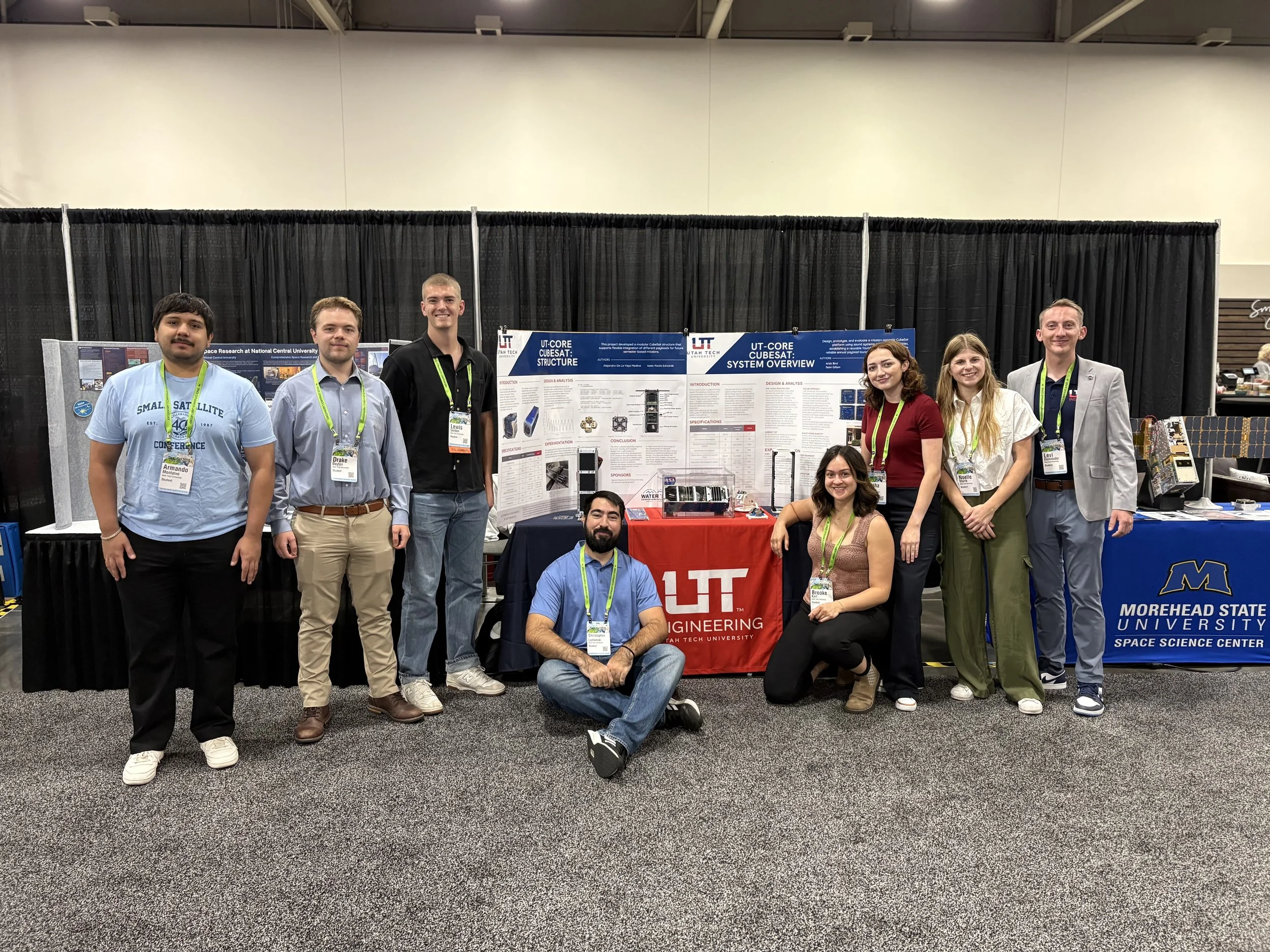
Utah Tech University students and faculty at the 40th Annual Small Satellite Conference in 2026, where the team show-cased its student-built CubeSats, shared engineering accomplishments, and connected with professionals in the aerospace industry.
The CubeSat initiative is also creating opportunities to engage younger students in aerospace engineering. Four local high school students participated in the project, visiting the Utah Tech campus on Friday afternoons to design, build, and test a Helmholtz cage, a specialized system used to simulate magnetic field conditions and evaluate the satellite's ability to stabilize its orientation in space.
Looking Ahead: A Mission to Support Utah's Water Resources
The team's ultimate goal is to launch Utah Tech University's first CubeSat into low Earth orbit in 2029, contingent upon securing a NASA CubeSat Launch Initiative opportunity. A planned application in 2028 would support this next major step in the program's development.
The proposed mission would use a Teledyne thermal infrared camera to map surface temperatures across Utah at approximately 65–75-meter resolution. The resulting data could contribute to water resource management efforts throughout the state, demonstrating how student-developed space technology can be applied to real-world challenges.
In preparation, successive student teams will continue refining and testing the CubeSat's communication systems, electronics, attitude controls, software, and scientific payload interfaces. The modular design and emphasis on documentation will help ensure that each new group of students can build upon the accomplishments of those before them.
Preparing the Next Generation of Aerospace Engineers
The Utah Tech CubeSat initiative demonstrates the impact of combining undergraduate education, hands-on engineering, and partnerships with established aerospace programs. Students are gaining practical experience in spacecraft development while strengthening their technical, problem-solving, teamwork, and project management skills—valuable preparation for careers in NASA-related fields and the broader aerospace industry.
Support from the Utah NASA Space Grant Consortium has provided essential funding for the CubeSat development effort, while the University Nanosatellite Program and NASA-related training opportunities have helped students and faculty establish the technical foundation needed to pursue increasingly ambitious missions.
For Utah Tech University, the project represents more than the development of a small satellite. It is establishing a lasting educational program that will give future generations of students the opportunity to design, build, test, and potentially launch spacecraft of their own—while contributing to Utah's growing aerospace workforce.
Take a closer look at the 3U CubeSat designed and built by Utah Tech University engineering students. Watch the video showcasing the satellite's core systems and the team's impressive engineering accomplishments.
